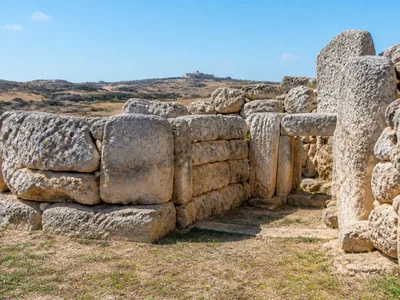
The Ġgantija Temples are Malta’s showpiece prehistoric ruins, a pair of megalithic sanctuaries on Gozo that are more than 5,500 years old and older than the pyramids of Egypt. Set on the edge of Xagħra, they are compact enough to see in a short stop yet rich enough in detail to reward anyone who cares about how early islanders built and worshipped.
Whether you visit as a quick detour on a gozo day trip or make them the reason you hop across from valletta, your experience depends on timing and expectations. Arrive early or late to sidestep bus tours and the mid‑day heat, allow time for the Interpretation Centre before you step onto the stones, and decide if you want to pair the temples with Ta’ Kola Windmill in Xagħra or head on to victoria cittadella for the island’s best viewpoint.
Quick answer: what are the Ġgantija Temples?
They are two monumental Neolithic temples built of limestone on Gozo, in use roughly from c.3600–2500 BC and preserved today as well-kept ruins within a walled precinct. They are part of the UNESCO World Heritage listing for the Megalithic Temples of Malta, inscribed in 1980 for their outstanding testimony to an early cult landscape. Local lore credits a giantess called Sansuna, a story that stuck because the cornerstones look like only a giant could have moved them.
What your visit depends on
If you want photographs without people, come at opening or close to last entry and do the outdoor circuit first. Families do well here because the walking is short, there is shade at the Interpretation Centre, and facilities are better than at more remote temple sites on Malta island. Mobility is not a barrier, and the nearest bus stop is 2 minutes on foot. If you are temple‑curious but not a prehistory fan, you will still come away impressed by the engineering, then you can spend the rest of the day swimming at the blue lagoon comino or exploring mdina rabat back on Malta.
Essential facts and quick stats
Two main temples stand within a single boundary, with traces of a third unfinished structure beside them. The southern temple stands 6 m high, and the whole complex shows a plan of a central corridor with five large apses branching off it. Built around c.3600 BC in limestone, the site was first cleared in 1827, with more archaeological work in 1933, 1936, 1949, 1956–57 and 1958–59. Managed by Heritage Malta and owned by the Government of Malta, it is open to the public and forms part of the Megalithic Temples of Malta UNESCO listing.
Getting there
You will find the site in Xagħra on Gozo, signed locally and easy to reach by short taxi ride from Victoria or by bus. The nearest bus stop is 2 minutes on foot. If you are driving, follow signs into Xagħra and look for the official parking near the entrance. Designated Blue Badge parking is available (where the site permits) on a first-come basis.
Tickets, prices and opening times
Ticketing is straightforward and you can buy on arrival at the Interpretation Centre. Adults €10; youth 12–17 €8; seniors 60+ €8; students €8; children 6–11 €6; infants 1–5 free. Heritage Malta members enter free, as do Heritage Malta Passport holders. A combo ticket with Ta’ Kola Windmill is available. Opening hours change seasonally, so check the official page before you set out and plan to arrive well before last admission.
How long to allow
A typical visit takes around 1 hour. Most people split their time between the Interpretation Centre and the stones, moving between the two main temples and lingering at the outer wall.
What it’s actually like on site
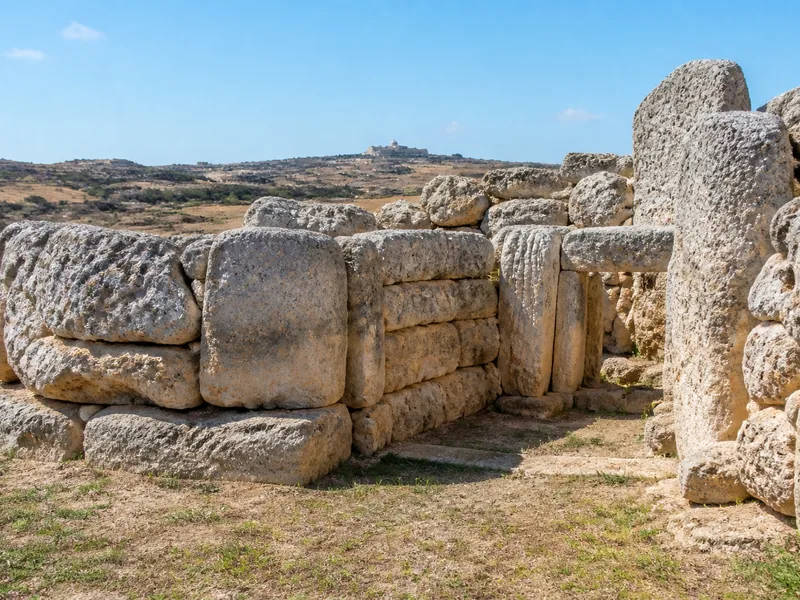
Entrance is through the Interpretation Centre, then a short path brings you out at the boundary wall with its stacked megaliths. The Ġgantija complex faces southeast. It faces the equinox sunrise. The first impression is scale: shoulder‑high stones are only the small ones here, the largest blocks stand taller than you and sit so cleanly that the curves of the apses still read clearly. Coralline limestone was used extensively. Globigerina limestone was used for inner furnishings. The complex is enclosed by an outer megalithic wall.
Even without a guide it is a readable building. You walk the spine of the central corridor and peel into the shallow apses on either side, noticing doorways with stone thresholds and sockets, niches that once took fittings in softer stone, and the slight rise as you move deeper into the sanctuaries. The atmosphere is calm on breezy days and can feel stark under noon sun, so bring water and a hat.
Layout, construction and highlights
There are two temples plus an incomplete third. Each uses a central passage with apses flanking it, the plan that became a hallmark of Malta’s megalithic architecture. The southern temple stands 6 m high at its best preserved wall, a figure that makes sense the moment you stand beside it. The alignment is not random, and the Ġgantija complex faces southeast, which means morning light washes the sacred spaces. It faces the equinox sunrise. The building stones are limestone, with Coralline limestone used for the tougher exterior blocks and Globigerina for inner fittings. If you look near the entrance you will notice a large stone cut with a recess, which some archaeologists have suggested might have served as an ablution station. Figurines found in association with the temples point to a fertility cult, though the open‑air feel and flaring apses show that any rites here would have had room for a gathering.
Interpretation Centre and displays
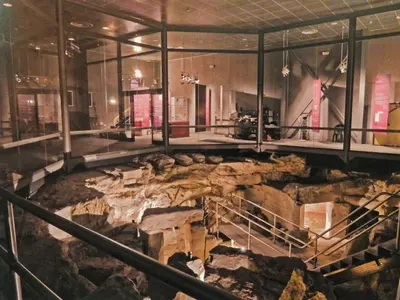
Start here if you like context. The Interpretation Centre displays Neolithic artefacts. Plaster fragments with red ochre are on display, a rare survival that helps you imagine the temples as colourful spaces rather than bare stone. The panels tie Ġgantija into the wider temple chain across Malta and Gozo, so if you are also visiting hagar qim and mnajdra or the underground chambers of the hal saflieni hypogeum, the story will click into place.
Visitor facilities
There is no restaurant or cafeteria. Food and drinks are available. A gift shop is available. Indoor and outdoor seating are available. Lockers are available. Nappy changing is available. Photography is allowed without a tripod. Flash is not allowed inside the Interpretation Centre. Assistance dogs are allowed.
Accessibility and parking
Fully accessible to mobility-impaired visitors. Paths and thresholds have been arranged so that you can see the main spaces without steps. Designated Blue Badge parking is available (where the site permits) on a first-come basis.
Families and children
This is one of the easiest major sites to visit with kids on Gozo. The circuit is short, there is shade at the start and end, and you can dip in and out of the open spaces without committing to a long loop. Children must be accompanied.
Nearby places to eat and other attractions
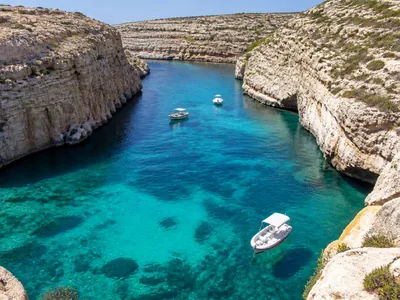
Xagħra has cafés and snack spots a short stroll from the entrance, handy given the lack of a restaurant at the site. Pair the temples with Ta’ Kola Windmill in the village, or make a circuit of Gozo’s highlights by adding victoria cittadella and a coastal stop before heading back towards the ferry for cirkewwa diving or a swim off Comino at the blue lagoon comino.
What to bring and what to wear
Wear flat shoes with some grip, and pack a hat and water in warm months. A light layer helps on windy days. Tripods are not allowed for photography, and leave the flash off inside the Interpretation Centre.
Common misconceptions
Many first‑timers think Ġgantija is a single building. In fact, there are two temples plus an incomplete third inside the boundary. Another surprise is how intentional the alignment is, with the southeast‑facing plan catching the equinox sunrise. Finally, despite the name that evokes giants, the engineering is human and clever rather than supernatural, using local limestone grades to best effect.
What is actually bookable here
- 3 bookable options via KKday and Klook
- about €80 to €97 per person at the time of checking
Taken from the operators' own listings, checked 15 September 2026. Ratings are theirs, not ours, and we do not host reviews.
Common questions
Is Ġgantija really older than the pyramids?
Yes. The temples are more than 5,500 years old and are older than the pyramids of Egypt.
How long do I need on site?
A typical visit takes around 1 hour. If you read every panel in the Interpretation Centre or sketch the stones, allow a little longer.
Can I take photos?
Photography is allowed without a tripod. Flash is not allowed inside the Interpretation Centre.
Is it accessible for wheelchairs or buggies?
Fully accessible to mobility-impaired visitors, with level access provided. Designated Blue Badge parking is available (where the site permits) on a first-come basis.
Are there guided tours?
Guided tours are available on request via Heritage Malta at the site.
Is there food on site?
There is no restaurant or cafeteria. Food and drinks are available, plus indoor and outdoor seating.
Last checked: 20 September 2026. Prices, opening hours and timetables change, verify anything time-sensitive before you travel. Photo: Diego Delso, CC BY-SA 4.0.